"I create psychologically charged worlds in which scale, symbolism, sound and historical painting traditions are used to transform personal experience into collective myth."
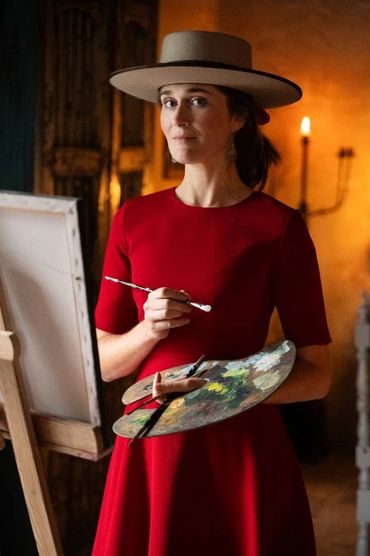
Úrsula Romero (1984) is an internationally recognised British painter whose emotionally charged and botanically symbolic works bring us closer to the mystical, the metaphysical and the sublime.
Úrsula Romero: Between Memory and Myth
Working across painting, installation and sound Úrsula Romero has developed a visual language in which flowers, plants, the human figure and fragments of her own personal history become important symbols for exploring themes of longing, grief, transformation, and identity.
Although botanical imagery has long been associated with her practice, to describe Romero as a botanical painter would be to misunderstand the depth of her work. In her paintings, flowers rarely function as botanical subjects in their own right. Instead, they operate as symbolic forms, carrying emotional, psychological and cultural meanings that extend beyond traditional scientific botanical painting. Her paintings are meditations on nature and the mysteries of us passing through space and time. She uses flowers and leaves as her muse to tell her own autobiography. She describes all of her works as self portraits.
Romero’s work draws upon a lineage of artists concerned not simply with representation, but with the transformation of inner experience into image. Echoes of Goya’s psychological ambiguity and El Greco’s spiritual distortion can be felt throughout her oil paintings. Yet these influences are absorbed into a visual language that remains distinctly her own, one in which botanical painting is transformed into allegory.
Central to Romero’s practice is an enduring interest in the relationship between what is seen and what remains concealed. Flowers and leaves are partially obscured, forms extend beyond the boundaries of the page, and visual information is deliberately withheld. This recurring technique creates works that resist complete resolution, inviting viewers to inhabit a space of uncertainty, memory and projection. The paintings do not seek to explain themselves fully; rather, they remain active in the imagination long after the encounter has ended.
The Úrsula Romero's fascination with scale also plays a significant role within her work. Monumental leaves and oversized botanical forms become are used to explore feelings of vulnerability, power, longing and disorientation.
Underlying Romero’s painting projects is a coherent investigation into the nature of human experience. The blue flower is a symbol of longing and pursuit. An arrangement of pansies painted during the global covid-19 lockdown is a meditation on thought, isolation and collective humanity. The female figure becomes a site upon which questions of ageing, grief, politics and identity are enacted. Across all of these works, personal experience is transformed into a broader symbolic language.
Romero’s practice ultimately inhabits a threshold between autobiography and mythology, memory and imagination, beauty and unease. Her works do not offer fixed narratives or singular meanings. Instead, they create spaces in which viewers are invited to confront their own memories, emotions and uncertainties. In doing so, they participate in a long tradition of artists who understand painting not merely as a means of depiction, but as a means of making visible those aspects of human experience that remain difficult to name.

Artist Statement
Artist Statement
Artist Statement
News
Artist Statement
Artist Statement
Projects
Artist Statement
Projects
Contact
Casa de la Morera, Estudio de Inky Leaves, Calle Cadiz, Albuñuelas, Granada, 18659, España
Estudio: www.casadelamorera.com